How can my business get recommended by ChatGPT?
Your business has a better chance of appearing when ChatGPT can understand what it offers, connect it to the buyer’s needs and find credible supporting information. Your website matters, but so do independent mentions, reviews and the context of the question. No one can guarantee an organic recommendation.
On this page
The short answer: Your business has a better chance of appearing when ChatGPT can understand what it offers, connect it to the buyer’s needs and find credible supporting information. Your website matters, but so do independent mentions, reviews and the context of the question. No one can guarantee an organic recommendation.
The more useful question is: when customers ask AI for a business like yours, who gets named instead? AIRanks helps businesses answer that question, understand their visibility gaps, and measure what changes after they act.
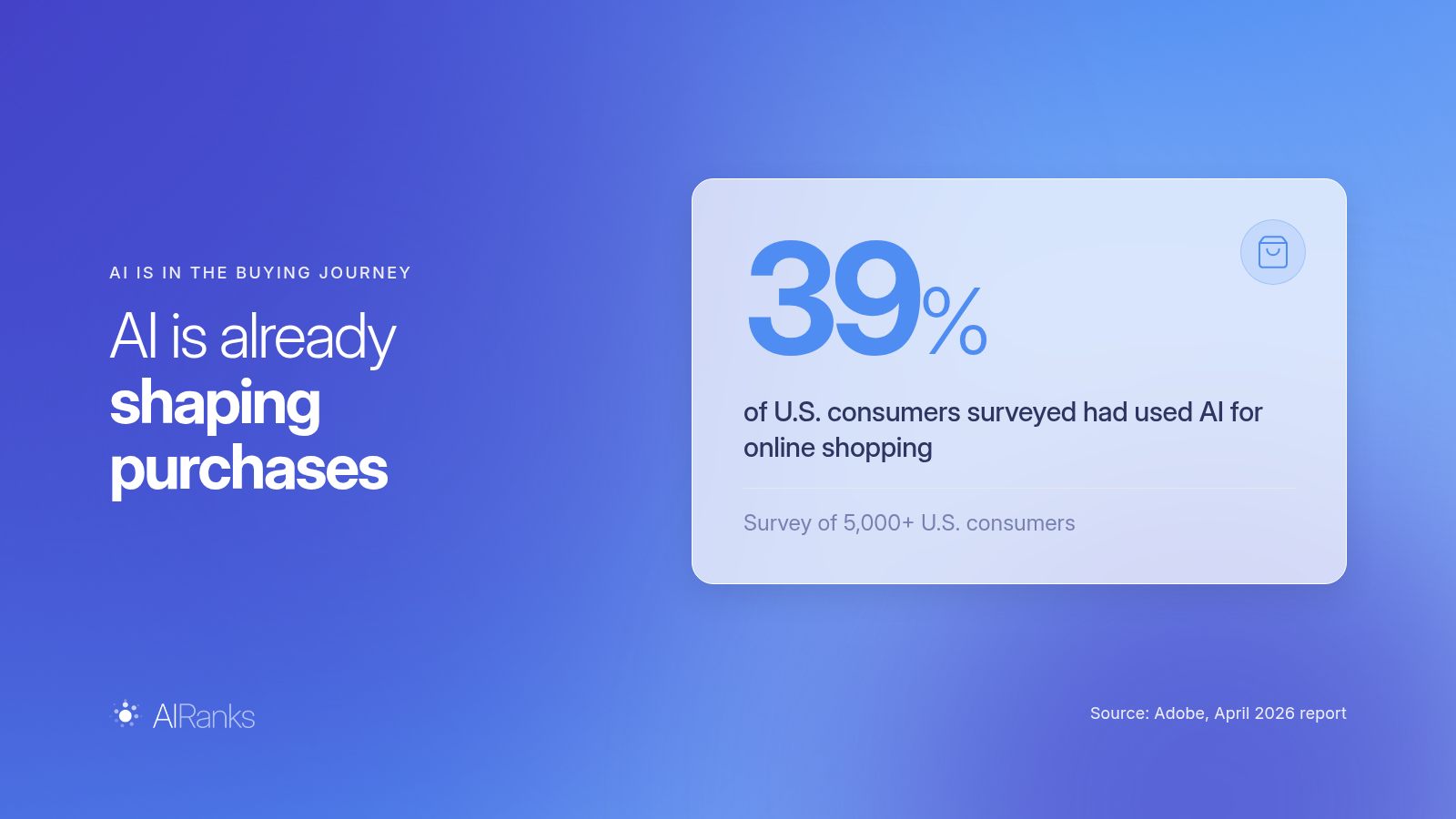
According to Adobe’s April 2026 report, 39% of respondents in a survey of more than 5,000 U.S. consumers had used AI for online shopping. By November 2026, AI discovery includes local search, product comparisons, advertising, and services that help users act on their decisions.
What has changed in AI recommendations?
ChatGPT is closer to the buying decision
According to OpenAI’s March 2026 product announcement, ChatGPT’s shopping experience now supports visual browsing, side-by-side comparisons, and more current product information. Its focus has shifted toward helping people decide, with merchants able to use their own checkout experiences.
AI visibility can mean entering a customer’s shortlist while they are comparing alternatives.
According to OpenAI’s search guidance, ChatGPT can also use location information for nearby results and help users find restaurant availability through supported providers. Availability varies by provider and location.
For an illustrative, anonymous HVAC company in Phoenix, the relevant context might be the service area, emergency availability, and customer need, not simply the broadest category keyword.
ChatGPT ads are here: paid and organic visibility
According to OpenAI’s launch announcement, U.S. ad testing began on February 9, 2026. According to OpenAI’s current guidance, eligible Free and Go users may see ads; Plus, Pro, Business, Enterprise, and Edu accounts do not. Accounts identified as belonging to minors are excluded.
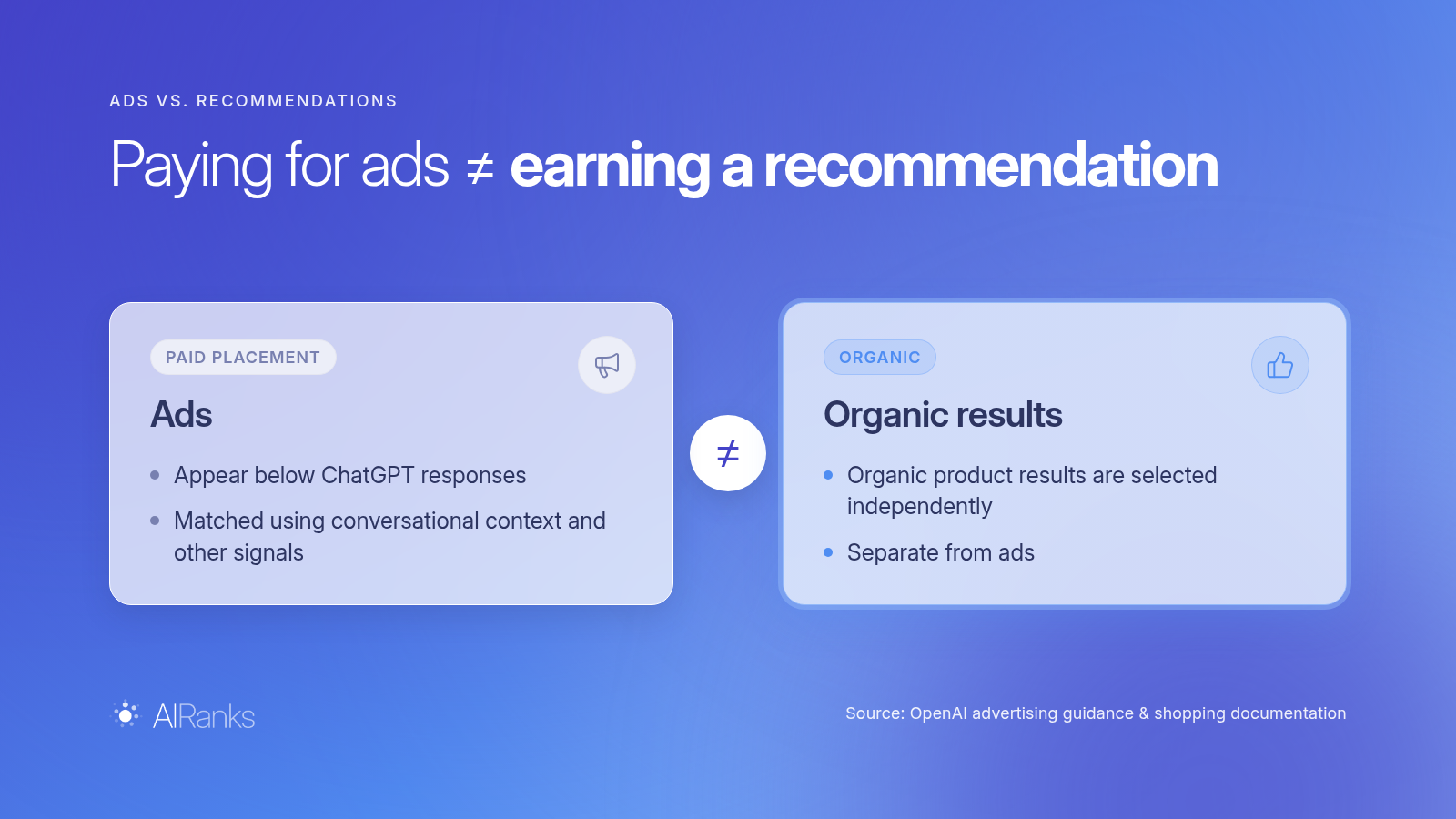
According to OpenAI, placements are labeled “sponsored” and visually separated from answers. According to its advertiser documentation, ads below responses include advertiser identity, text, imagery, and a landing-page link. Matching considers conversational intent and, when personalization is enabled, select broader user signals, not access to private chats for advertisers.
According to OpenAI’s retail-ad documentation, catalog ads can appear as individual product cards or carousels. According to its consumer guidance, a multi-image format during image generation is also being tested.
According to OpenAI’s May 5 announcement, advertisers can buy through partners or beta self-serve Ads Manager; Axios independently reported the U.S. rollout. Access remains subject to availability, eligibility, and review.
According to OpenAI’s policy, advertisers cannot shape, rank, or alter organic answers. Paid visibility and GEO are complementary channels: the stronger strategic position is to pursue both where relevant, while measuring them separately. Neither guarantees inclusion or sales.
ChatGPT is not the whole market
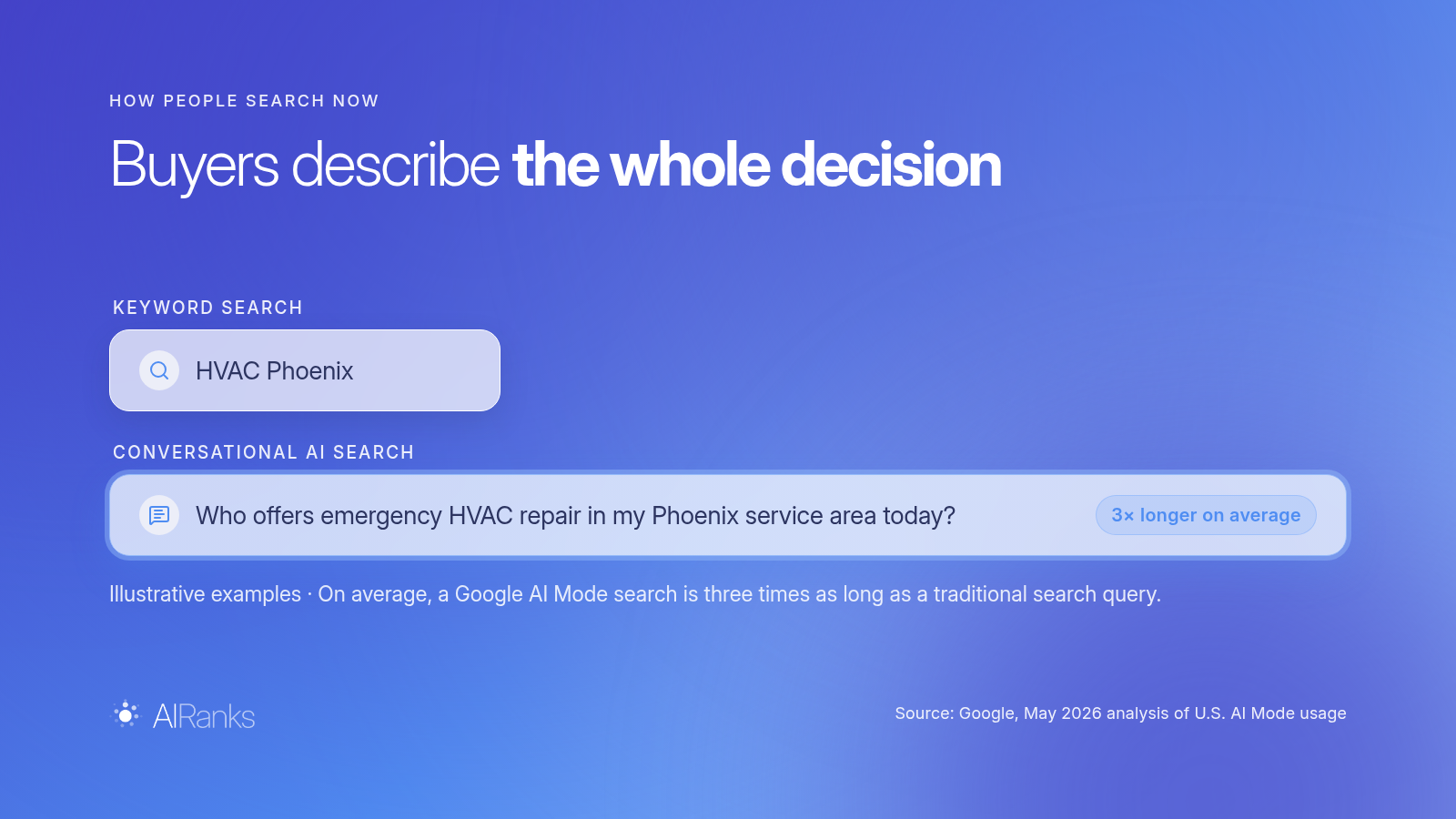
According to Google’s May 2026 analysis of U.S. AI Mode usage, the average AI Mode search is three times as long as a traditional search query. Customers are describing more of the decision, not just naming a category.
Google’s AI Overviews and AI Mode, Gemini, and Perplexity belong in the wider discovery picture. A single ChatGPT screenshot cannot represent all those experiences.
AI is beginning to act, not just answer
According to Google’s January 2026 commerce announcement, its Universal Commerce Protocol was designed to connect discovery, buying, and post-purchase support, with initial checkout plans focused on eligible U.S. retailers.
The direction is important even where those features are unavailable: an assistant increasingly needs enough reliable information to compare vendors and help complete a task. Being persuasive to a human reader is not always the same as being clear enough for an AI-assisted decision.
What ChatGPT looks at when recommending a business
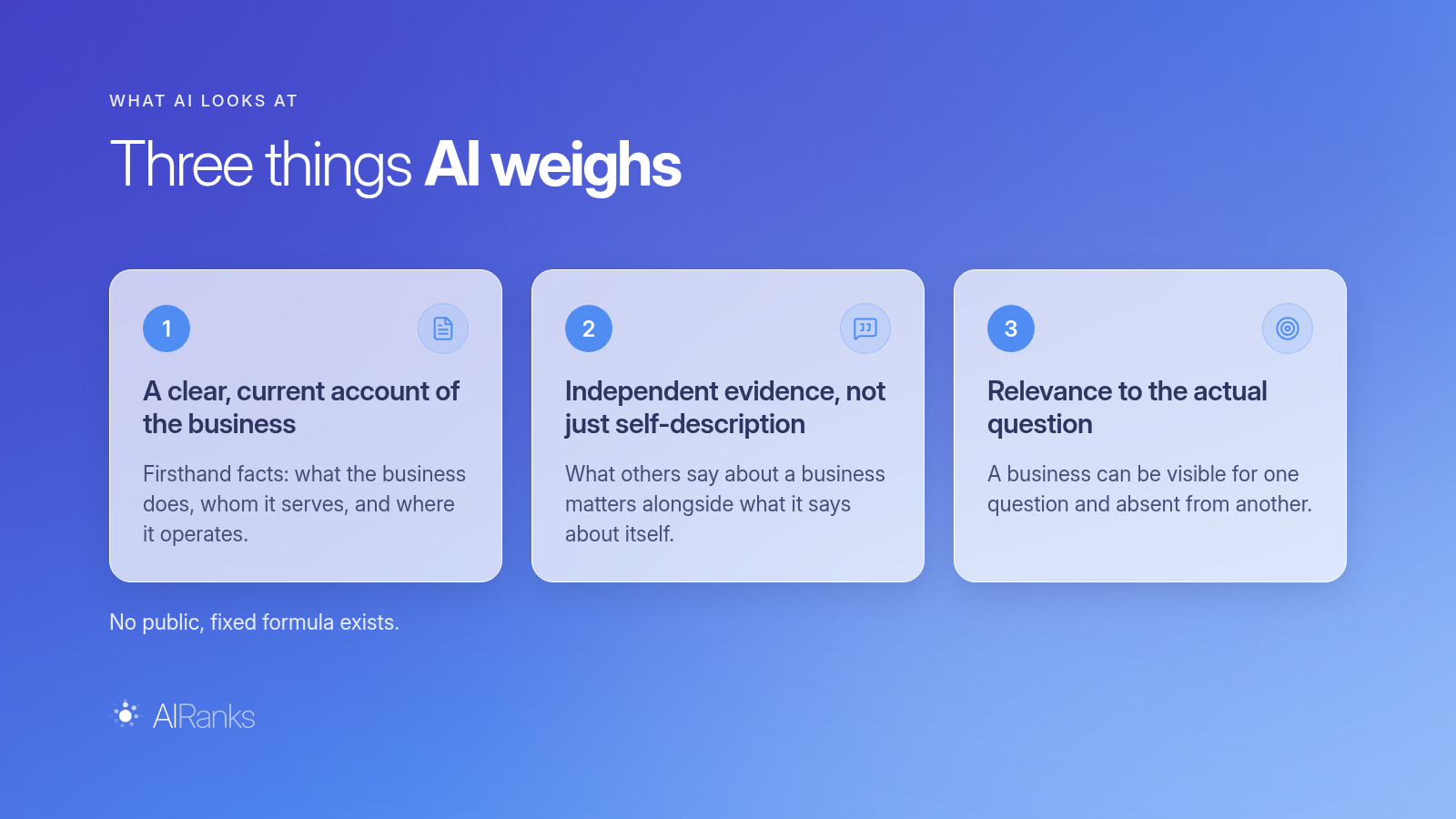
There is no public, fixed formula for earning a recommendation. Search-based answers, model knowledge, and personal context can contribute differently. Broad research patterns are clues, not a universal ranking recipe.
A clear, current account of the business
The website remains an important source of firsthand facts: what the business does, whom it serves, and where it operates. Outdated services or conflicting information make that account less dependable. Fresh content matters when it adds current facts, not just a new date.
According to Ahrefs’ research updated in October 2026, recent citation patterns increasingly favored original sources, including official brand pages, research bodies, and hands-on testers, over some aggregators.
Independent evidence, not just self-description
According to Ahrefs’ November 3, 2026 study, analysis of 10,000 U.S. brands and 260 million non-branded AI prompts found that off-site mentions correlated with AI visibility across ChatGPT, AI Mode, and AI Overviews. Reddit mentions showed the strongest combined relationship among the mention types studied.
Correlation is not causation, and national patterns do not predict every local market. The broader lesson: what others say about a business matters alongside what it says about itself.
Independent reviews, specialist publications, useful forum discussions, and relevant business listings can all contribute to that public picture. They are not interchangeable, and no single platform guarantees inclusion.
Relevance to the actual question
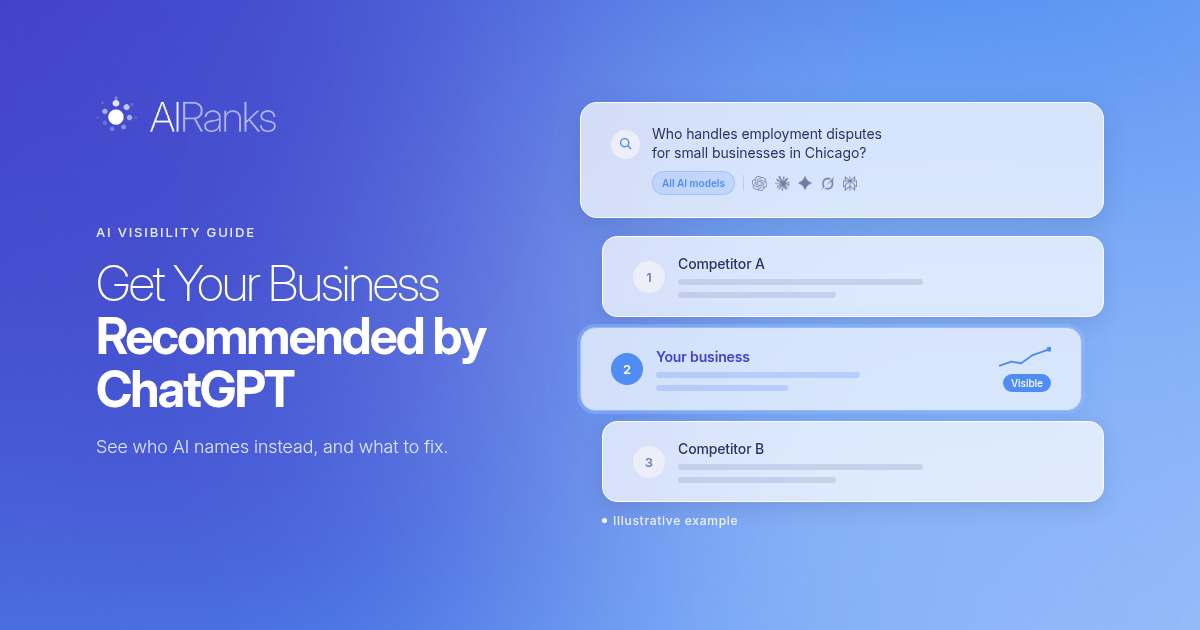
Illustrative questions for an anonymous Chicago law firm (“Which law firm should I choose?” and “Who handles employment disputes for small businesses in Chicago?”) describe different decisions. A business can be visible for one and absent from the other.
According to OpenAI’s shopping documentation, product selection considers the user’s intent, context, first- and third-party information, and factors such as reviews and availability. Those are disclosed shopping factors, not a published ranking formula for every local service.
In another illustrative example, an anonymous U.S. Shopify brand might appear for a broad product category but disappear when a shopper adds a specific use case. That gap is worth measuring; it is not proof of poor product quality.
Does AI visibility matter if referral traffic is small?
According to SE Ranking’s June 2026 study, AI platforms accounted for 0.32% of total website traffic in its dataset for January to April 2026. The research covered 101,574 websites; it is a sample, not a census of the internet.
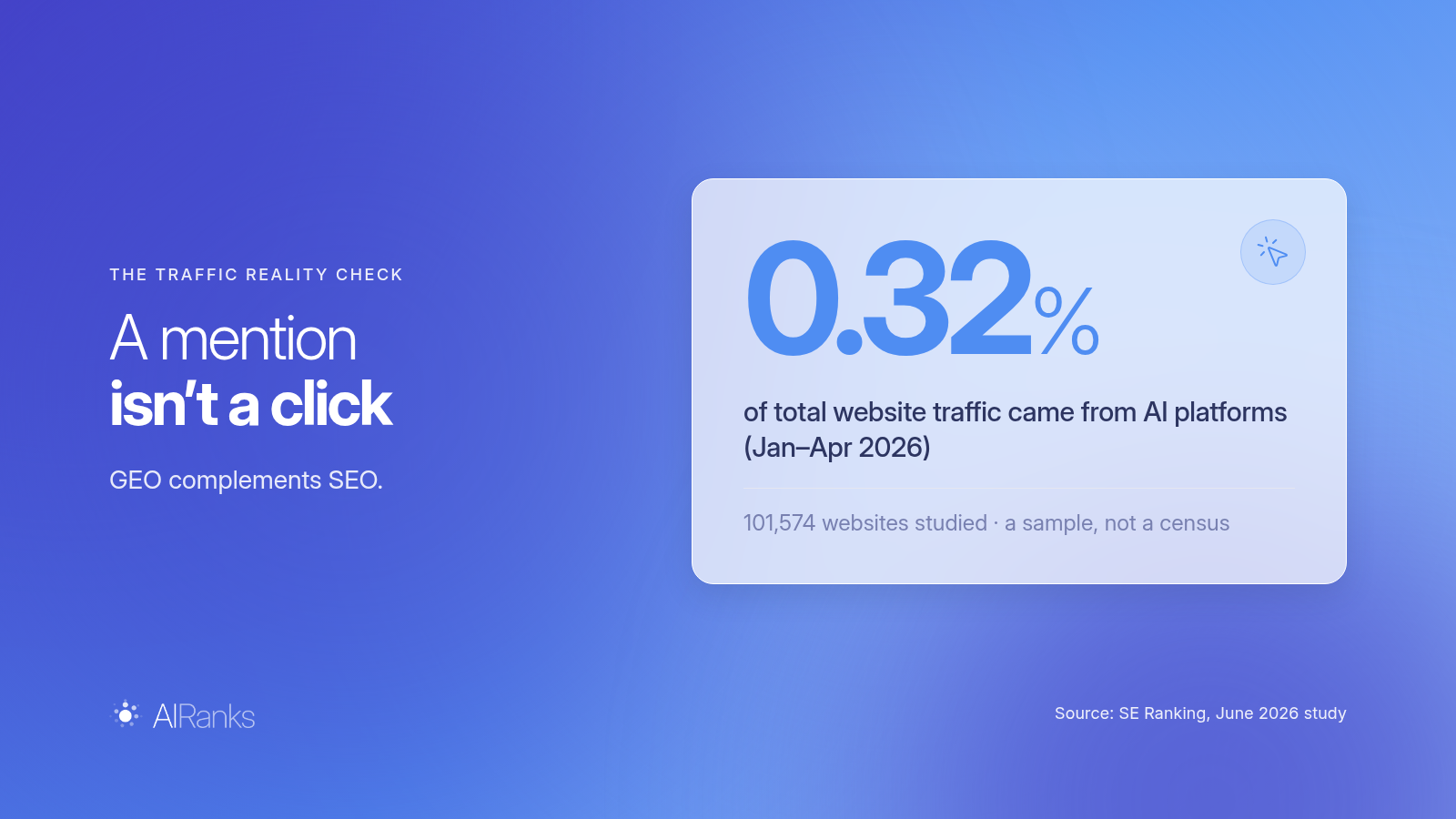
The number argues against abandoning traditional search. It does not tell the whole story of discovery: a mention inside an answer and a click to a website are different events.
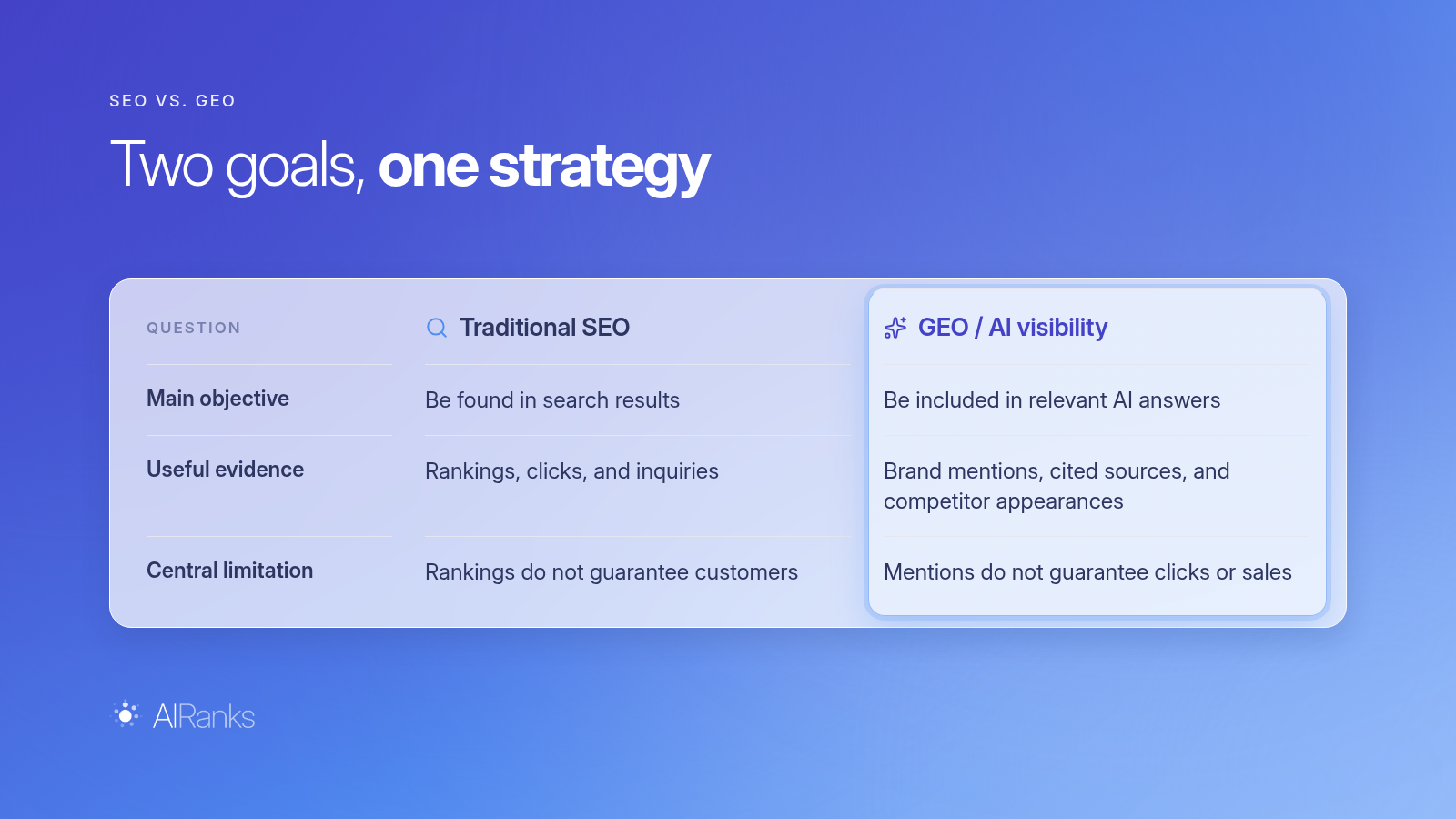
| Question | Traditional SEO | GEO / AI visibility |
|---|---|---|
| Main objective | Be found in search results | Be included in relevant AI answers |
| Useful evidence | Rankings, clicks, and inquiries | Brand mentions, cited sources, and competitor appearances |
| Central limitation | Rankings do not guarantee customers | Mentions do not guarantee clicks or sales |
GEO complements SEO. Neither should be judged only by an attractive screenshot.
Common mistakes businesses make
Treating one answer as a verdict. Wording, location, context, and platform changes can alter the result. A single successful test is not a stable market position.
Publishing more without adding evidence. Generic articles and unsupported “best” claims do not establish why the business deserves consideration.
Chasing Reddit as a shortcut. Genuine discussion and manufactured promotion are different things. A correlation study is not an invitation to seed fake recommendations.
Measuring only traffic, or only mentions. Visibility, factual accuracy, and inquiries answer different questions. None should stand in for the others.
How AIRanks helps businesses get recommended by AI
AIRanks connects the question “Why does AI recommend my competitor?” with something a business owner can examine: the actual questions, answers, and visibility problems behind that result. Its role is to make those gaps measurable and provide recommendations for addressing them, not to promise a place in every answer.
A free scan shows where the business stands
The free AIRanks scan asks ChatGPT and Gemini 6 real questions customers ask AI assistants, each one twice. It shows whether your business is visible and which competitors appear instead. The scan takes about two minutes, with no card required.
An action plan turns gaps into priorities
AIRanks’ paid plans provide an action plan with concrete recommendations for addressing AI-visibility problems. Rather than leaving a business with a score alone, the recommendations explain what needs attention and why it matters to the questions being tracked.
Re-scans show whether anything changed
Every AIRanks plan re-scans the tracked questions once a week. After taking action, businesses can check which questions now include them, where they remain absent, and which competitors have risen or dropped in the recorded answers.
The central benefit is ownership of the evidence: you can measure your own AI visibility yourself. A changed answer is not proof that one particular action caused it, but repeated scans give the business a clearer view than a one-off screenshot.
From AI visibility to a business decision
AIRanks makes that question visible, then connects the findings to an action plan and ongoing measurement. The free scan is a starting point, not a guarantee of future recommendations.
Frequently asked questions
Can I pay to get recommended by ChatGPT?
Yes, you can pay for ChatGPT ads, subject to advertiser eligibility and availability. These are clearly labeled sponsored placements shown alongside, rather than inside, organic answers. According to OpenAI, ads do not influence its answers. Paid ads and organic visibility are separate channels, best measured separately. Advertising does not purchase an organic recommendation, and neither channel comes with guaranteed results.
Does GEO replace SEO?
No. Search visibility still matters. GEO adds measurement of whether AI assistants include your business in relevant answers and what they say about it.
Do reviews or Reddit mentions guarantee inclusion?
No. They can form part of the public evidence around a business, but relevance, source quality, platform behavior, and user context also matter.
Can AI recommendations differ between U.S. cities?
Yes. Location and the wording of a question can change which sources and competitors appear. Visibility in one city should not be assumed to represent another service area.
How can I check my business today?
Run the free AIRanks scan for ChatGPT and Gemini. It asks 6 real customer questions, each one twice, in about two minutes, with no card required, and shows whether your business or its competitors appear.
How often can I check whether my AI visibility improved?
AIRanks re-scans your questions once a week on every plan. After taking action, you can compare which questions now name your business and which competitors have risen or dropped. Repeated checks show changes in recorded answers, not guaranteed results.
Sources
- Adobe’s April 2026 report
- OpenAI’s March 2026 product announcement
- OpenAI’s search guidance
- OpenAI’s launch announcement
- OpenAI’s current guidance
- OpenAI
- advertiser documentation
- OpenAI’s retail-ad documentation
- consumer guidance
- OpenAI’s May 5 announcement
- Axios independently reported the U.S. rollout
- OpenAI’s policy
- Google’s May 2026 analysis of U.S. AI Mode usage
- Google’s January 2026 commerce announcement
- Ahrefs’ research updated in October 2026
- Ahrefs’ November 3, 2026 study
- OpenAI’s shopping documentation
- SE Ranking’s June 2026 study
- AIRanks’ paid plans
- OpenAI