How we choose the questions we track
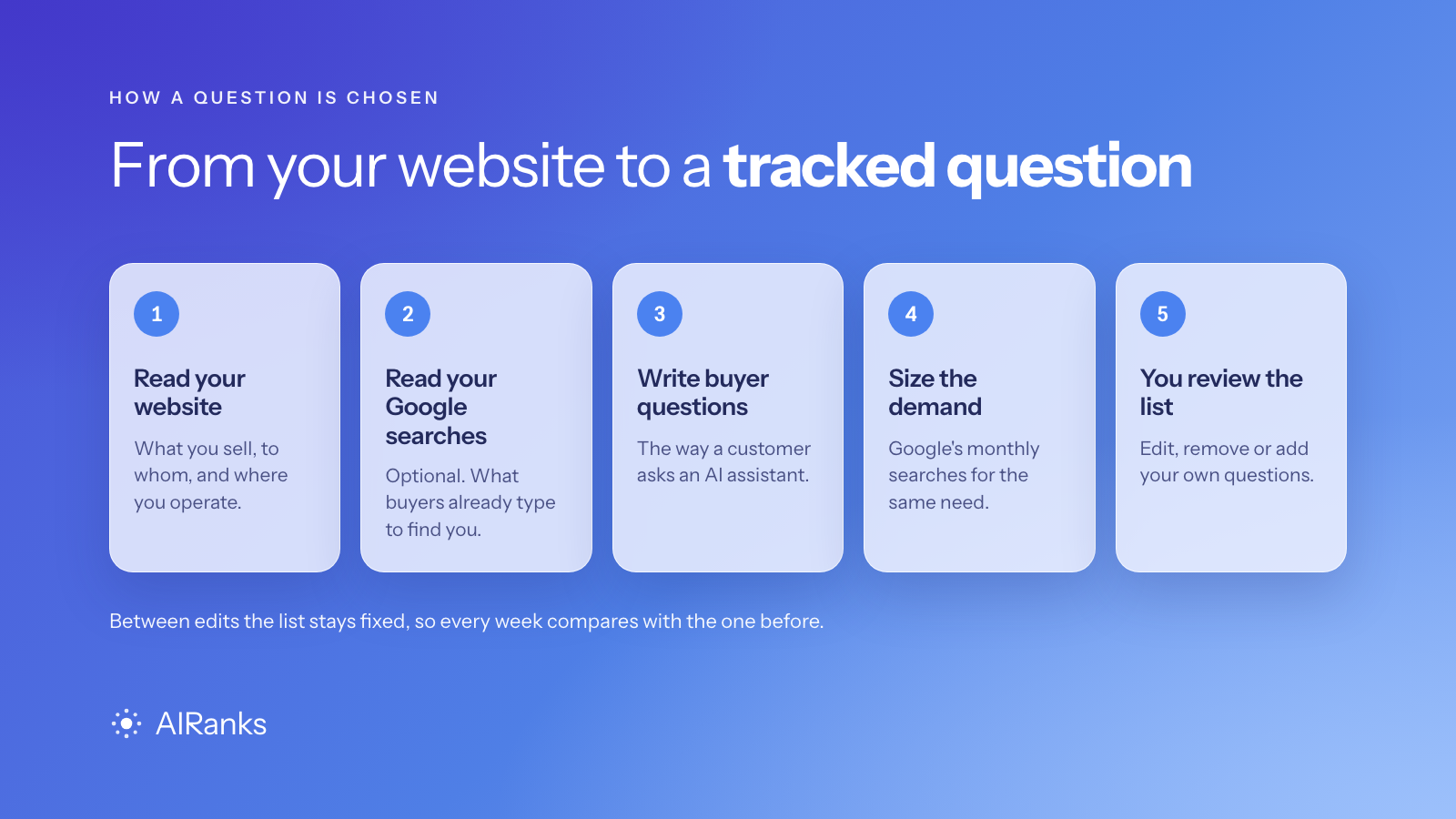
We write each question the way a real customer would ask an AI assistant, using three kinds of evidence: what your website says you sell and where, the Google searches that already bring people to your site, and Google's own monthly search figures for the same need in your market. The list is yours to edit, and between edits it stays fixed so every week can be compared with the one before.
On this page
The short answer: We write each question the way a real customer would ask an AI assistant, using three kinds of evidence: what your website says you sell and where, the Google searches that already bring people to your site, and Google's own monthly search figures for the same need in your market. The list is yours to edit, and between edits it stays fixed so every week can be compared with the one before.
Your AI visibility is a simple share: the number of AI answers that named your business, out of all the answers to your questions. That makes the question list the most important decision in the whole measurement. Ask the wrong questions and the percent describes a market nobody is in. This article explains how the list is built, which data goes into it, and how every number beside a question is calculated.
The data we use
| Source | What we read | What it is used for |
|---|---|---|
| Your website | The page title, the description, the language, the structured data and the visible text of your homepage | What you sell, to whom, and where you operate |
| The market you confirm | The city and country you serve | Which place every question is asked for and asked from |
| Google Search Console (optional) | The 40 searches that showed your site most often in the last 12 complete weeks, with impressions and clicks | Which services, needs and places real buyers look for |
| Google Ads Keyword Planner | Google's average monthly searches over the last 12 months, for your city and your country | How much demand stands behind each question |
One thing is missing from this table on purpose: a count of how often people ask an AI assistant a given question. No AI company publishes that number, so we do not show one and we do not estimate one.
Your website
Before any question is written we read your homepage and build a short profile of the business: the name customers know you by, your category in plain words ("dentist", "boutique hotel", "project management software"), one sentence on what you sell and to whom, and whether you serve one city, one country or customers worldwide.
The location comes from evidence on the page, such as the address, the phone code, the language and the domain. If you confirm a city and country yourself, that is used exactly as given. Where the page gives no evidence, the field stays empty. We never invent an address.
Your Google searches
When Search Console is connected, questions written from then on also draw on the searches that showed your website in Google over the last 12 complete weeks: the 40 with the most impressions, each with its impressions and clicks. This is the closest thing to a record of what your buyers actually type.
The connection is read only, and disconnecting deletes everything that was read. It is in limited release while Google reviews our app. Until it opens to every account, questions are written from the website and the market, and sized with Keyword Planner in the same way.
Google Keyword Planner
Keyword Planner is the tool Google gives advertisers to see how often a search is made. We use it for one figure only: the average number of monthly searches on Google Search over the last 12 months, in the place your business serves.
How a question is written
Every question on your list follows the same rules.
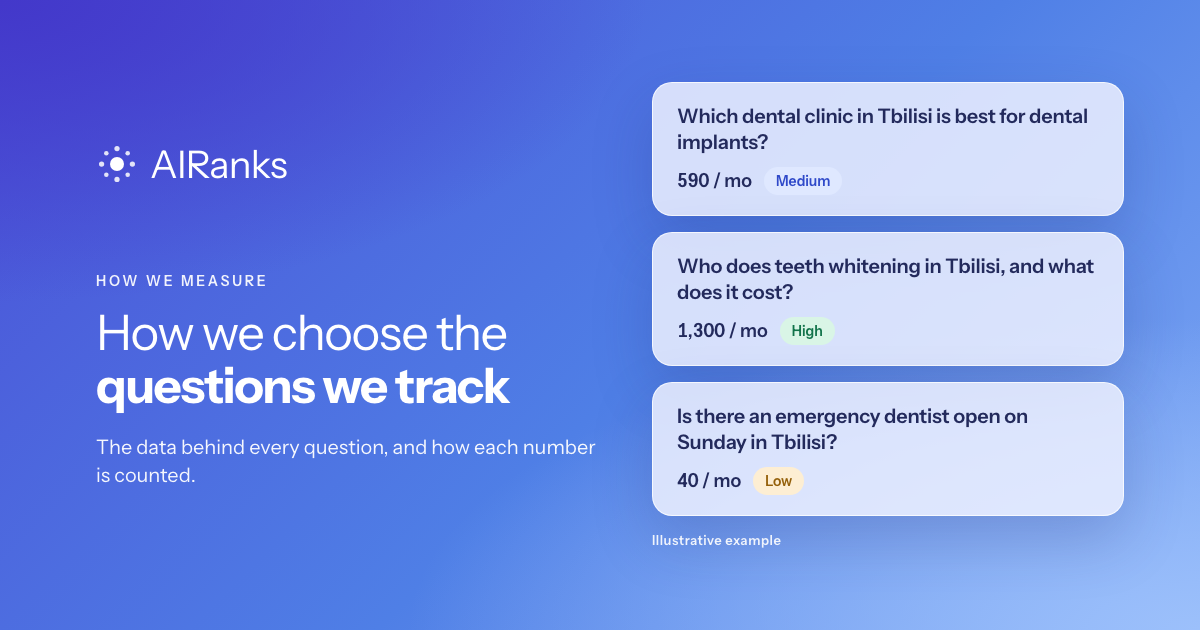
It reads like a customer, not a keyword. People type "dentist tbilisi" into Google. They ask an assistant "Which dental clinic in Tbilisi is good for implants?". We track the second form, because that is what the assistant answers.
Most questions do not name you. These are the buyer questions: the customer does not know your business yet and is asking who to choose. They are the only questions that count toward your AI visibility.
A few questions do name you. Up to 6 questions ask about your business directly, each about something different a customer checks before choosing: what you offer, whether you are good, prices, reviews, location and opening hours, how you compare with others. They show what AI says about you, and they never count toward AI visibility, because an answer to a question that contains your name will almost always name you.
Local questions name the place. If you serve one city, every buyer question names that city. If you serve one country, it names the country.
No question is asked twice. New questions are checked against the ones already on the list, ignoring capital letters, spacing and the final question mark, and the writer is told to cover other services, needs and ways of asking instead of rewording what is there.
When your Google searches are available, three more rules apply:
- Buyer questions are based on the services, needs and places those searches show, the most searched first.
- Each one is written as a full question a buyer would ask an assistant, never as a copied keyword.
- A search that contains your business name is treated as interest in your brand, not as a buyer question, and searches that have nothing to do with choosing a business like yours are ignored.
| A search from Search Console | The question we track |
|---|---|
| dental implants tbilisi | Which dental clinic in Tbilisi is best for dental implants? |
| teeth whitening price | How much does teeth whitening cost in Tbilisi, and which clinics are recommended? |
| your clinic's name + reviews | Not a buyer question. It is covered by the questions that name you. |
The searches and questions in this table are an illustrative example.
How the demand number is calculated
Beside every question on your list you see a number such as "590 / mo" and a label: High, Medium or Low. Here is exactly where it comes from.
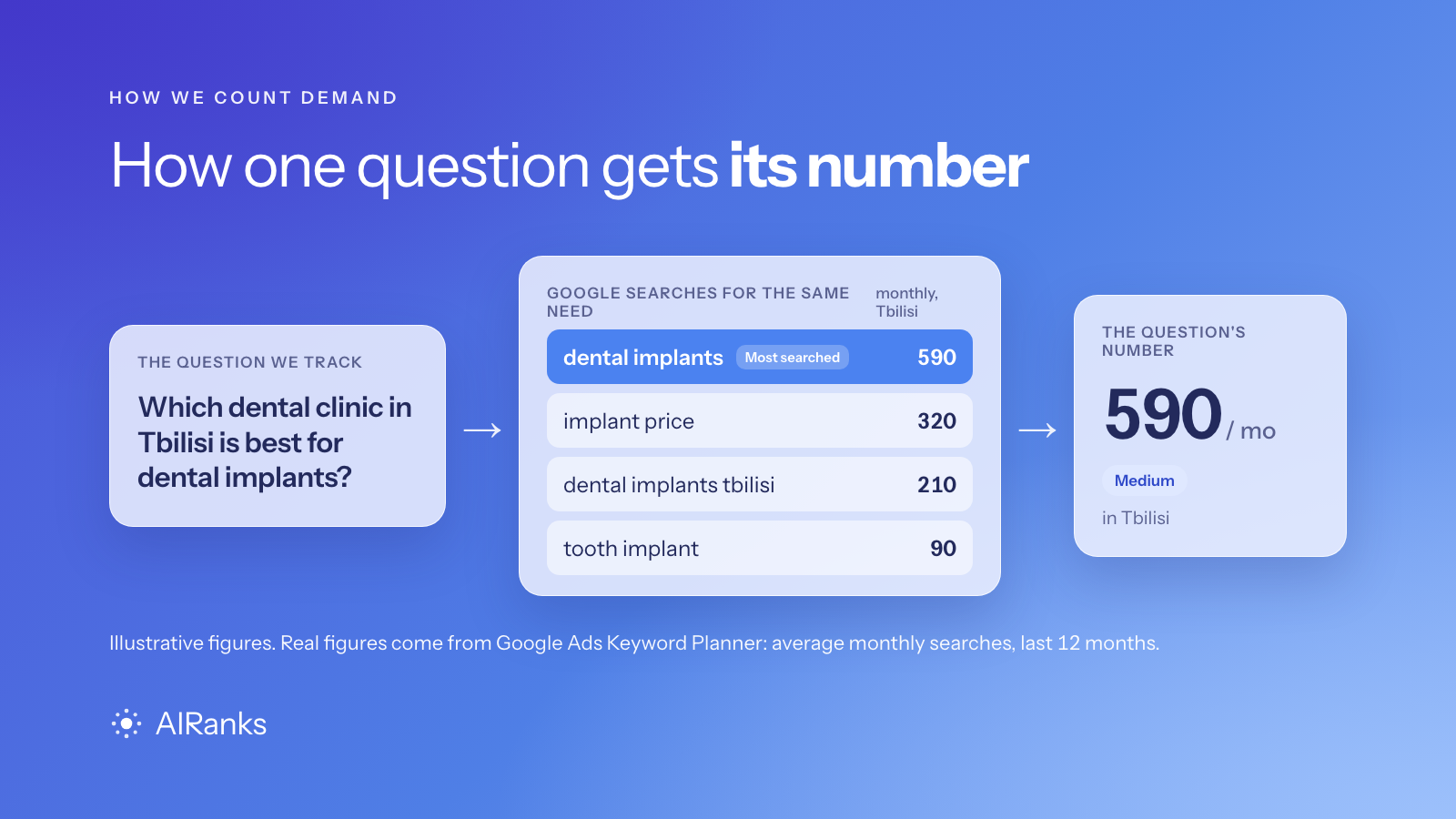
Step 1. The question becomes Google searches. For each question, an AI model writes up to 4 searches that people type into Google for the same need. They are short (1 to 5 words) and use the words people really use: product and service names, "price", "best", "near me". When the need is local, one search includes the city and one does not. Where people commonly search in two languages, both forms are written. A business name is never added if the question did not contain one.
Step 2. Google gives each search a figure. We ask Keyword Planner for the average monthly searches of each one, twice: once for your city and once for your whole country. Google groups close variants, such as plurals and spacing, under one figure.
Step 3. The most searched one becomes the question's number. We call it the parent keyword. If its figure in your city is 10 or more, we use the city figure. If the city has too few searches, we use the figure for the whole country and say so beside the number.
Step 4. The number gets a label.
| Label | Monthly Google searches |
|---|---|
| High | 1,000 or more |
| Medium | 100 to 999 |
| Low | 10 to 99 |
| Not enough search volume | Under 10, or no figure from Google |
A question with no figure gets no number. It is marked "Not enough search volume" and we never fill the gap with a guess. Such a question can still matter to your business; it simply cannot be measured this way.
Step 5. The total counts each search once. The figure at the top of the list is the sum of every question's parent keyword. If two questions share the same parent keyword, that search is counted once, not twice. Questions without enough search volume add nothing.
A worked example
Take a dental clinic in Tbilisi with three questions. The figures are illustrative.
| Question | Searches behind it (monthly, Tbilisi) | Result |
|---|---|---|
| Which dental clinic in Tbilisi is best for dental implants? | dental implants 590, implant price 320, dental implants tbilisi 210, tooth implant 90 | 590 a month, Medium. Parent keyword: "dental implants" |
| Is there an emergency dentist open on Sunday in Tbilisi? | No search reaches 10 in Tbilisi. In all of Georgia: emergency dentist 40 | 40 a month, Low, counted for the whole country |
| Which clinic in Tbilisi offers sedation dentistry for anxious adults? | Google has no figure for any of them | Not enough search volume. No number is shown |
The total for this list is 590 + 40 = 630 searches a month.
What the number means, and what it does not
- It measures demand for the topic, not for the exact question. It tells you how many people look for this need on Google each month. It does not tell you how many people ask ChatGPT.
- It never changes your AI visibility. Every buyer question counts the same in the percent, whether its label is High or Low. Demand is there to help you decide which questions deserve a place on the list and which fixes to do first.
- It is refreshed. Monthly figures are read again after 30 days, and the searches behind each question are rewritten after 90 days.
The list is yours to change
The list we write is a starting point, built from evidence. When you buy a plan, the first scan starts on its own with that list, so you have results the same day. In scan setup you can then edit any question, remove it, add your own or have more written up to your plan's size, and sort the list by most searched to see where the demand is. A plan tracks 15 questions, or 20 to 100 in steps of 10, for each business. If you track more than one market, the same list is asked in each city or country.
Between edits, the list stays fixed. Every week the same questions go to ChatGPT, Gemini, Claude and Perplexity, set to your location, so this week's percent can be compared with last week's. If you change a question later, a new series starts and the dashboard marks the break instead of quietly comparing two different lists. The rest of the method is on How we measure.
After tracking starts: your searches beside each question
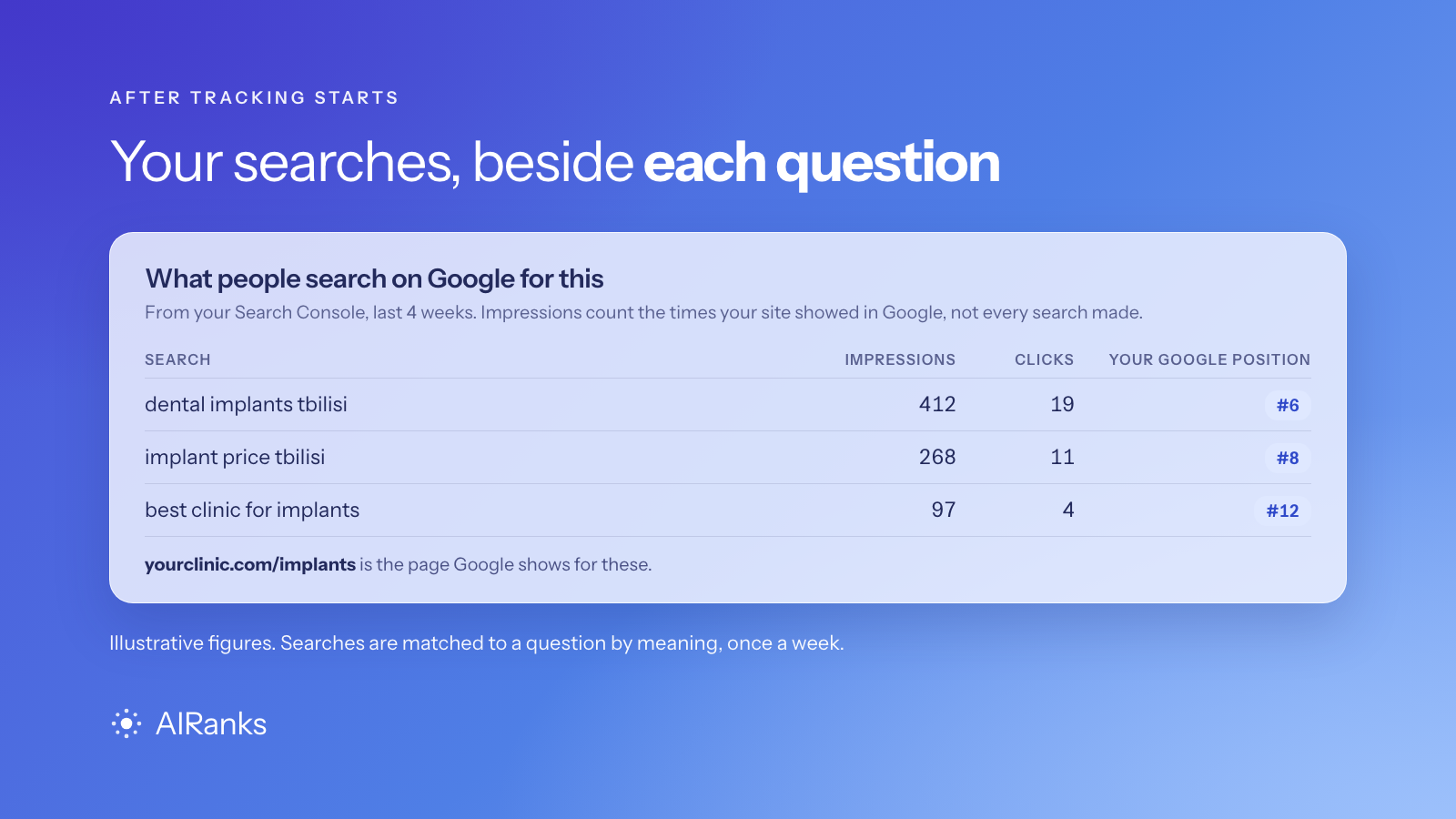
With Search Console connected, the work does not stop at the list. Once a week an AI model matches your most seen searches of the last 4 weeks to your tracked questions. A search matches a question by meaning, not by shared words: it matches when a person typing it wants the answer the question asks.
On each question's page you then see the matching searches with their impressions, clicks and your Google position, and the page of your site that Google shows for them. That page is usually the first one worth improving, because assistants that read Google's results read it too.
One caution about these figures. Impressions count the times your site showed in Google, not every search that was made. They are evidence of what people look for, not a measure of the whole market. That is why the market size comes from Keyword Planner and your own reach comes from Search Console, and the two are never mixed.
The limits of this method
- Google searches are a proxy. People phrase things differently in an assistant: according to Google's analysis of AI Mode usage in the U.S., the average AI Mode search is three times as long as a traditional search.
- Keyword Planner has no figure for rare searches, and often none for searches in smaller languages and scripts. Those questions show "Not enough search volume" even when real people ask them.
- Your first list is written from your homepage. If an important service is not mentioned there, add a question for it yourself.
- Google AI Overviews, Google AI Mode and Microsoft Copilot are not measured yet.
See your own questions
The free AIRanks scan writes 6 questions for your business, asks ChatGPT and Gemini each one twice, and shows whether you were named and who was named instead. It takes about two minutes, with no card required.
Frequently asked questions
Can I track my own questions?
Yes. You can edit, remove or add questions in scan setup. The questions we write are a starting list built from evidence, and you know your customers better than any data source.
Do you know how often people ask ChatGPT a question?
No, and neither does anyone outside the AI companies, because they do not publish it. We show Google's monthly searches for the same need instead, and we label it as demand for the topic.
Does a question with low search volume lower my AI visibility?
No. Search volume is never part of the percent. AI visibility is the share of answers to your buyer questions that named your business, and every buyer question counts the same.
Do I have to connect Google Search Console?
No. Without it, questions are written from your website and your market, and each one still gets its monthly search figure from Keyword Planner. Connecting it adds your real searches as evidence.
Why do questions that name my business not count?
An answer to "Is this clinic good?" will name the clinic almost every time. Counting those answers would raise the percent without telling you anything about whether new customers find you.
What happens if I change a question later?
The change starts a new series. Weeks are only compared when they asked the same questions in the same way, so the dashboard marks the break and compares from there.
How many questions should I track?
Enough to cover the services that matter to your revenue, in the places you sell them. Plans start at 15 questions for a business and go up to 100.