Businesses in ChatGPT is big news—and it puts OpenAI in direct competition with Google
On November 10, 2026, OpenAI launched Businesses in ChatGPT in beta. Companies can claim a profile, keep their information current, and see aggregated engagement data. Eligible U.S. ecommerce and online service businesses can also publish an AI Business Agent that customers can chat with.
On this page
The short version: On November 10, 2026, OpenAI launched Businesses in ChatGPT in beta. Companies can claim a profile, keep their information current, and see aggregated engagement data. Eligible U.S. ecommerce and online service businesses can also publish an AI Business Agent that customers can chat with. From our view at AIRanks, this is big news: ChatGPT is moving into territory Google has long owned—business listings and the moment a customer finds and contacts a company.
What OpenAI actually announced
According to OpenAI’s announcement, the beta is aimed at the 1.2 billion people the company says use ChatGPT each week. It has two parts:
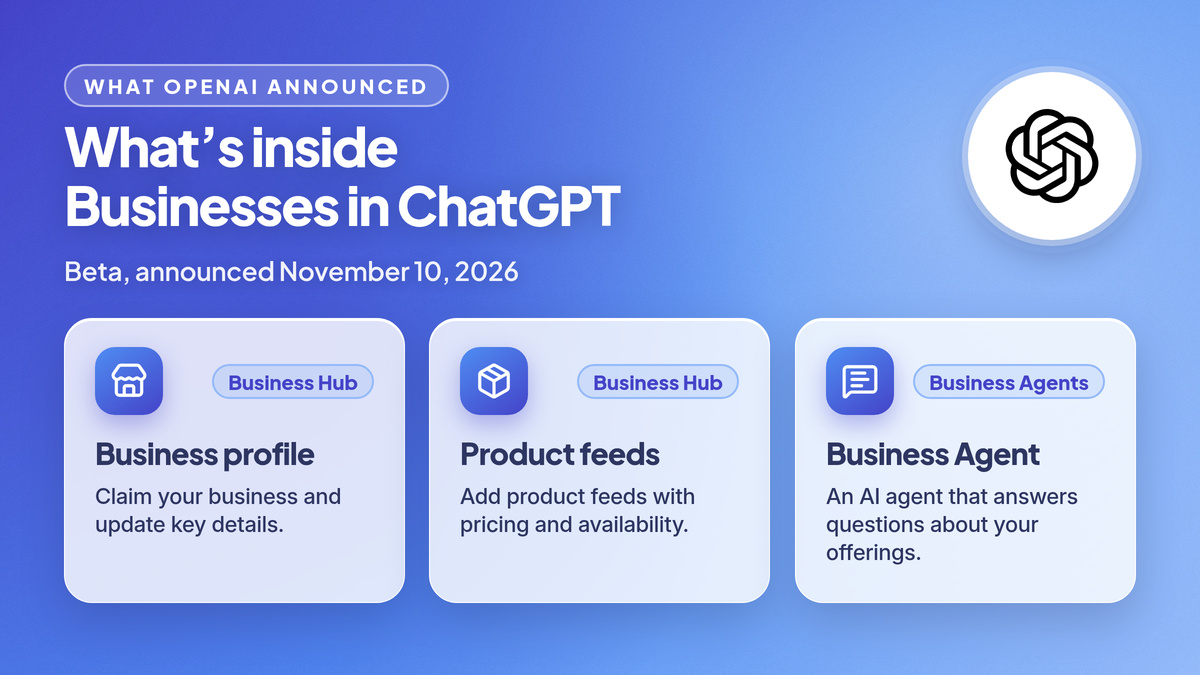
Businesses in ChatGPT has two parts: Business Hub profiles and Business Agents.
- Business Hub. Companies can claim their business, update key details, add product feeds with pricing and availability, and view aggregated insights: mentions, website clicks, and “discovery topics,” the common themes in conversations where their website is cited.
- Business Agents. After claiming a business, eligible organizations can build, test, and launch an AI agent that answers questions about their offerings.
OpenAI also says businesses can sponsor a Business Agent and use it as the destination for ChatGPT Ads. Sponsored placements are labeled and kept separate from ChatGPT’s responses.
Can ChatGPT really “talk to” business bots?
Yes, with an important limit. This is not ChatGPT negotiating with other bots on its own. According to OpenAI, when a business appears in an answer, people can click to see its ChatGPT profile. If the business has an agent, the customer can choose to start a conversation.
That conversation is labeled, separate from the original chat, and distinct from ChatGPT’s independent answers. VentureBeat described the result as a shopper comparing brands, then opening a separate conversation with an AI representative of one seller.
For now, the agent is an explainer, not a checkout. According to OpenAI’s help center, it can explain products and policies and link to the website, but it cannot complete purchases, make bookings, or check orders.
Who can join—and where
Claiming a profile is open to eligible businesses where ChatGPT is available, if the person is authorized to represent the company and passes verification. OpenAI’s help center says neither an ads account nor an Enterprise agreement is required. Local stores and restaurants can currently claim only an existing U.S. listing.
Agents are narrower: eligible U.S. ecommerce and online service businesses with a website. VentureBeat reported that both profile management and agents were free at launch, citing Digiday, and that OpenAI left open the possibility of charging later. It also reported that sponsored agents are in a limited test with selected advertisers.
Why this puts OpenAI in direct competition with Google
OpenAI’s announcement does not mention Google. The comparison comes from the press. The Decoder wrote that the feature could compete with Google’s business-profile tool by placing business profiles inside a conversational interface. InfotechLead said it was designed to compete with Google Business Profile, Yelp, and other discovery platforms. Zeebiz asked whether ChatGPT can challenge Google in online discovery.
Our read: this is a direct challenge. Google built its position on being where customers look for a business and where owners keep that listing accurate. OpenAI is now offering a verified profile, owner-supplied information, performance data, and a sales conversation inside the place where customers already compare options.
The challenge is early, and the coverage is balanced. InfotechLead noted that OpenAI has not shown it can match Google’s local search coverage, navigation, or review ecosystem. Google does not have to lose for ChatGPT to matter. A customer only has to start a decision somewhere else.
ChatGPT vs. Google for local discovery
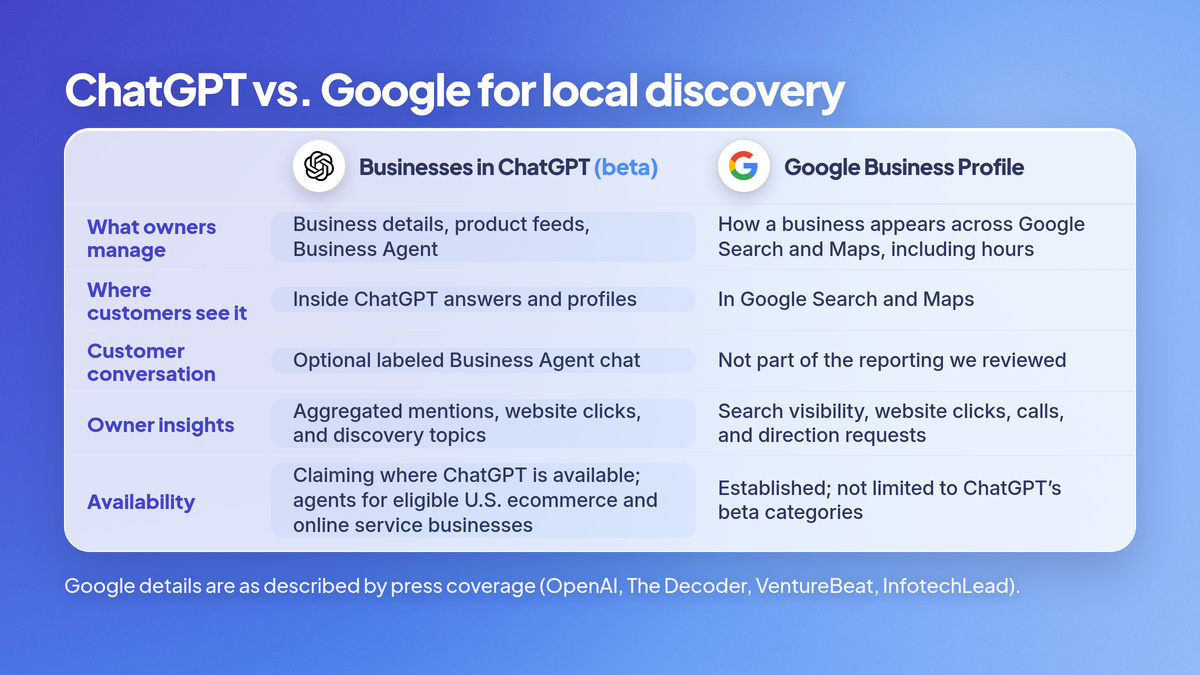
Businesses in ChatGPT vs. Google Business Profile at a glance.
| Businesses in ChatGPT (beta) | Google Business Profile | |
|---|---|---|
| What owners manage | Business details, product feeds with pricing and availability, Business Agent | How a business appears across Google Search and Maps, including details such as hours |
| Where customers see it | Inside ChatGPT answers and profiles | In Google Search and Maps |
| Customer conversation | Optional labeled Business Agent chat | Not part of the reporting we reviewed |
| Owner insights | Aggregated mentions, website clicks, and discovery topics | Search visibility, website clicks, calls, and direction requests |
| Availability | Claiming where ChatGPT is available; agents for eligible U.S. ecommerce and online service businesses | Established; not limited to ChatGPT’s beta categories |
Sources: OpenAI, The Decoder, VentureBeat, and InfotechLead. Google details are as described by those outlets.
What this means for U.S. businesses
AI visibility is becoming a customer channel. A buyer may now meet your business inside an answer, a profile, or an agent conversation before visiting your website. “AI traffic” undersells that shift.
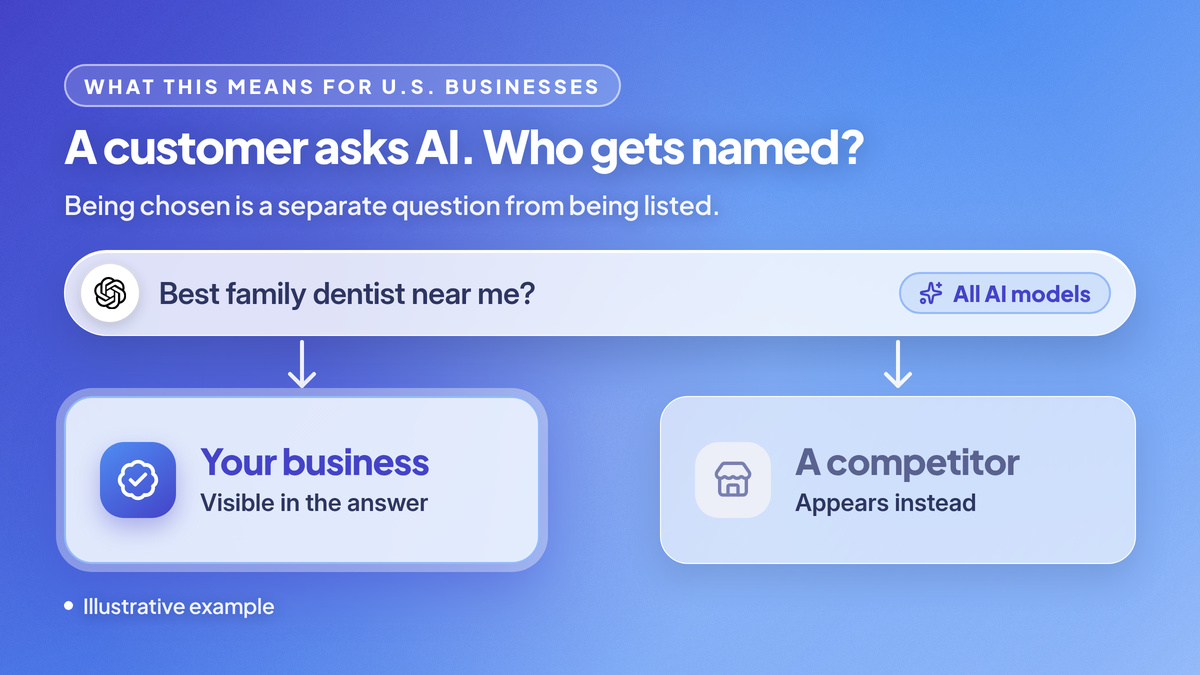
Illustrative example: being listed is not the same as being chosen.
Being chosen is a separate question from being listed. According to OpenAI, ChatGPT continues to make independent recommendations and comparisons, and claiming a business does not guarantee higher placement or sales. Supplying information is not the same as being selected.
The risk is a competitor appearing instead. The announced insights cover your mentions, clicks, and discovery topics. OpenAI’s help center says discovery topics are aggregate themes, not individual prompts. Nothing in the announcement describes a view of which questions you missed or which competitors were named instead.
It is still a beta. Eligibility depends on business type, location, and verification, and some categories may be deferred. Treat this as a major signal, not a finished market.
How AIRanks helps businesses see where they stand
First-party data tells you what happened inside one platform. AIRanks is built to show what customers see across assistants, and who appears when you do not.
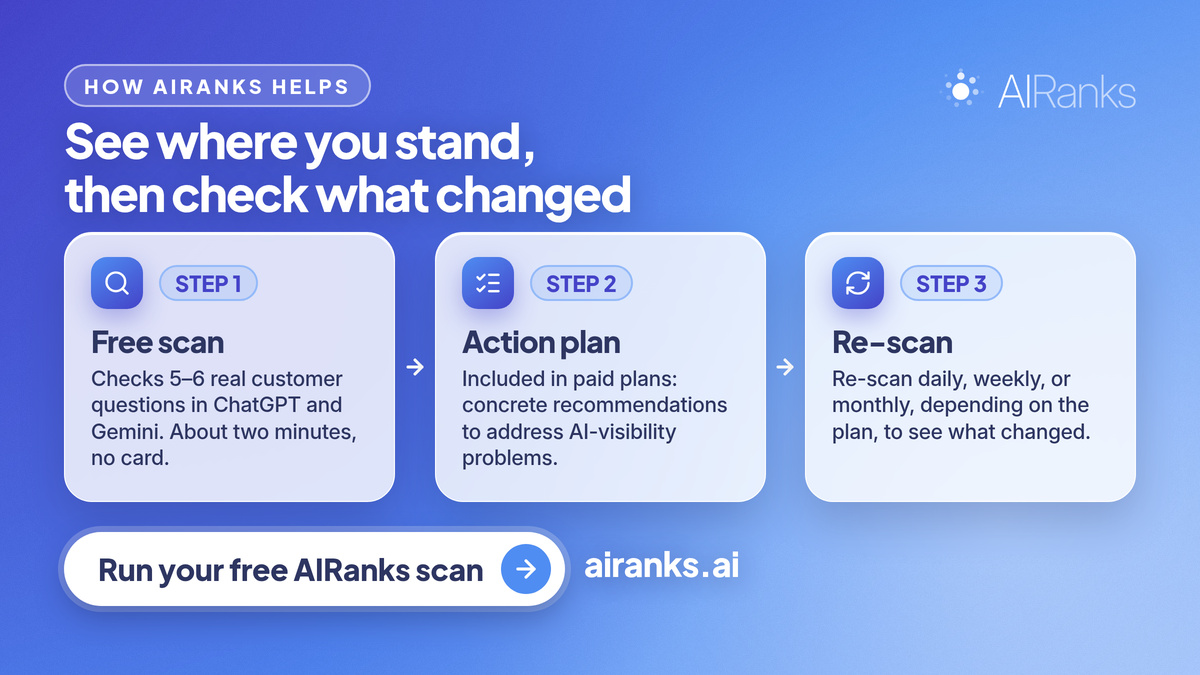
Scan, act, re-scan: how AIRanks tracks AI visibility.
Start with a free scan
The free scan checks 5–6 real questions customers ask AI assistants in ChatGPT and Gemini. It takes about two minutes, requires no card, and shows whether your business is visible or which competitors appear instead.
Paid plans add an action plan
AIRanks’ paid plans include an action plan with concrete recommendations for addressing AI-visibility problems.
Re-scan to see whether anything changed
After taking action, you can re-scan daily, weekly, or monthly, depending on the plan. You can see which questions now include your business and which competitors rose or dropped. You can measure your own AI visibility yourself.
AIRanks also offers ChatGPT Ads services alongside GEO, because paid and organic visibility are separate channels. For the fundamentals of organic recommendations, read our guide to getting your business recommended by ChatGPT. Neither channel comes with guaranteed results.
Frequently asked questions
What is Businesses in ChatGPT?
It is a beta from OpenAI, announced November 10, 2026. Eligible businesses can claim a profile in Business Hub, manage information and product feeds, and view aggregated engagement insights. Eligible U.S. ecommerce and online service businesses can also publish a Business Agent.
Does claiming my business guarantee ChatGPT will recommend it?
No. OpenAI says ChatGPT continues to make independent recommendations and comparisons, and claiming does not guarantee higher placement or sales.
Can any business create a Business Agent?
No. Agents are currently limited to eligible U.S. ecommerce and online service businesses with a website that meet OpenAI’s policy requirements. Some businesses can manage a profile without qualifying for an agent.
Does this replace Google Business Profile?
Not according to the reporting we reviewed. Press coverage describes Businesses in ChatGPT as a challenger, while noting that Google’s local search, navigation, and review ecosystem is established. The two are now competing for the same moment of customer discovery.
How can I find out whether ChatGPT names my business or a competitor?
Run the free AIRanks scan for ChatGPT and Gemini. It checks 5–6 real customer questions in about two minutes, with no card required, and shows whether your business is visible or which competitors appear instead. Re-scans can then show whether anything changed.